


Buy the Pixel 10 if you mainly want a compact phone for everyday photos, messaging and maps. The Pixel 10 Pro makes more sense if you use zoom regularly, take a lot of group selfies or need more than 256 GB of local storage. Both screens measure 6.3 inches, so you don’t have to carry a bigger phone to get the Pro cameras.
Quick answer: Start with the Pixel 10 if you mainly shoot in daylight and want a true 5× zoom without paying for the Pro. Pay extra for the Pro if you use the ultrawide or selfie camera often, or if the extra display brightness will make a difference outdoors.
What does the Pro add to the cameras?
Both phones have a dedicated 5x optical telephoto lens. The regular Pixel 10 pairs its lens with a 10.8 MP sensor, while the Pro uses a 48 MP sensor. The Pro also has a 48 MP ultrawide, compared with 13 MP on the regular model. On paper, those are meaningful upgrades if you shoot views from stadium seats, want room to crop travel pictures, or often use the ultrawide for interiors. Megapixels alone don’t predict how well a camera handles a moving subject or low light.
Google advertises zoom up to 20x on the Pixel 10 and 100x on the Pro. Neither number represents optical zoom. If you’re deciding in a shop, try the 5x setting on both phones under the same lighting, then crop the image to see how much usable detail remains. For group selfies, try fitting the same people into the frame at arm’s length. The Pro has a wider front camera field of view.
Where the regular Pixel 10 keeps up
Both use Google’s Tensor G5 chip, and both displays reach 120 Hz. The base model has 12 GB of RAM, compared with 16 GB on the Pro. The Pro’s higher-resolution display can drop to 1 Hz, while Google lists a 60–120 Hz range for the Pixel 10. A lower minimum refresh rate is useful for static content, but the spec alone doesn’t tell you which phone will last longer in your day.
Charging is a tie on paper. Google quotes up to 55% in about 30 minutes for either phone using a separately sold compatible 30 W USB-C PPS charger or higher. Both support up to 15 W Qi2 wireless charging. Google lists a typical battery capacity of 4,970 mAh for the Pixel 10 and 4,870 mAh for the smaller Pro. Don’t use the Pro XL’s charging specs to make this comparison.
Make the decision at the same storage size
Compare the price of 256 GB against 256 GB before counting a trade-in or financing deal. If both offer enough space, put the difference toward the Pro only if a specific feature matters to you. If you already keep a large offline photo and video library, the 512 GB and 1 TB options on the Pro are a clear reason to consider it. Check local stock and warranty terms before buying, especially on imported or refurbished listings.
Manufacturer references: Google Pixel 10 specifications and Google Pixel 10 Pro specifications. This guide compares manufacturer specifications, not hands-on battery or camera tests.
The checkout test: What does the Pro actually cost you?
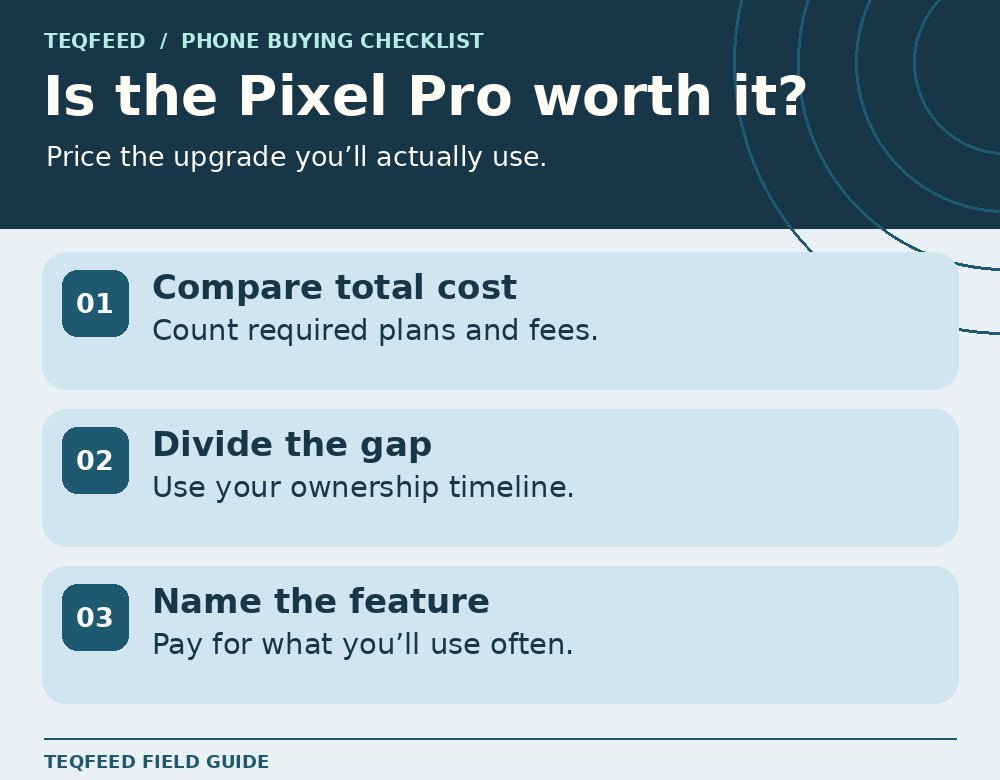
Put the specific offers side by side and calculate the total you’ll actually pay. Include taxes, delivery and any required plan upgrade, then subtract only discounts that apply to you. If a carrier spreads a discount across monthly credits, check what happens if you switch plans or leave early. The sticker-price difference and the amount you’ll pay can be quite different.
Divide the real price gap by how long you expect to keep the phone. A hypothetical $180 difference over three years works out to $5 a month. Then ask what you’ll use for that money. If you can name a recurring use, like cropping distant subjects on trips or keeping a large offline video library, the premium is easier to justify than if it only buys a feature you might try once.
If one offer is for a refurbished phone and the other is for a new one, check battery condition, warranty and returns before comparing the totals. A bargain is less useful if you can’t return the phone after testing the feature you paid extra to get.
Watch: Google Pixel 10 vs Pixel 10 Pro: Which one to get?
A hands-on comparison of these exact two phones to complement the specifications in this guide. Prices and offers in the video may no longer apply.